Follower – Chris Abrahams – Sound Pilgrim

I first heard Australian musician Chris Abrahams back in 2001 on Aether, the resplendent, endless sunrise of an album he recorded with his legendary band, The Necks. I listened to it obsessively and have been a fan ever since, but recently began exploring Abrahams’ solo work. His latest, Follower, released at the end of 2022 on the prodigious Room40 label, has become my new obsession.
“Costume” opens on a rolling fog-bed of eerie organ over which Abrahams slowly layers his materials. Bells ring, but their sound is almost coincidental, as if someone were idly lifting them and looking them over while thinking about something else. Piano drops in tentatively, an approach that feels mournful and ruminative. Abrahams gently recycles a handful of notes in a tight range, laying them down in shifting patterns. Electric keys emerge and swell, holding a chord. The track, the longest on the album, coheres as it progresses yet never accumulates or assumes a shape. From the depths of this conjecturing atmosphere, a harsh, distorted swell emerges, proceeding in billows. It takes over the soundscape and envelops it in a corrosive mist. Upper register notes on the piano re-emerge tentatively to clear the air – but the piece suddenly ends.

Abrahams’ piano playing on Follower is restrained, even minimal. It can sound at times as if he’s intentionally limited the number of notes he’s allowed himself to work with, and is trying different combinations of the same six or seven notes to decipher a code. As a result, the emphasis falls less on his melodies – though he wrings many colors and moods from such constrictions – and more on his rhythms and attack. To focus solely on his piano playing, however, is to miss the point as Abrahams brings a continually surprising array of percussive textures to these tracks as well.

“New Kind of Border,” starts quietly and is quickly ignited by Abrahams’ insistent style and trim keyboard runs. But while he plays, the track rattles and jangles and crackles in a hectic welter that continually threatens to overtake and disrupt the proceedings. With Abrahams’ intuitive sensitivity to what works, everything thrashes together with steady, palpable tension. The piece effectively resolves itself with a soothing, repeated three-note gesture.

“Sleep Sees Her Opportunity” offers up a rangy, mesmerizing environment, struck through with muted, atonal sprays of piano: frosty, one-handed runs that splinter into fragments in their flight and that put me in mind of the chillingly spectral prepared piano from the second movement of Arvo Pärt’s “Tabula Rasa.” A submerged but steady thud like a panicked heartbeat drives the track forward through bursts of shivering, chattering static, yet the overall mood remains one of mystery rather than dread.

The final track, “Glassy Tenseness Of Evening,” starts with what sounds like a stubborn car engine that won’t turn over. Soon enough, echo-drenched knocks and odd rumbles and throbs burst in, adding a previously unheard, cavernous dimension to the album, followed by Abrahams’ gentle, confined keyboard motifs. As the track progresses to its end, the engine sound recedes and is replaced by a heavily muffled throb, keeping the tension on high while the piano dreams its cyclical dreams.

In my many listens to this album, I keep coming back to its title, Follower. Follower of what, exactly? Abrahams seems to me to be in egoless pursuit of his own voice. He’s not interested in virtuosic display, something he could readily fall back on, so much as in making a space in which the fusion of contrasting sounds can emerge and express something new and uncanny. With this album, I think he succeeds brilliantly.
Eidolon – Siavash Amini – The Thing Itself

The origin of the term “thin place” can be traced to Celtic/Christian culture, and a rough definition might be a location that exists as a conduit or gateway between the immediate world and a metaphysical, ethereal realm right next to it. However, the location of any given thin place is a bit harder to pin down, since a thin place tends to “exist” both subjectively and globally, beyond boundaries and nationalities. But it’s as much an uncanny feeling about a place as it is the place itself, a sensation of other lives having passed through a place but possibly still existing in it as trace element and shadow. A nexus of the real and the imagined, a simultaneity of the is, the was, and the may be.

In a way, Iranian musician and composer Siavash Amini’s latest album, Eidolon, released on Lawrence English’s brilliant and unstoppable label Room40, is a musical thin place – a space in which Amini explores the 13th century tuning systems of Safi-al-din Urmavi, while hoping to capture a glimpse of any nascent wraiths or eidolons that might be found there. As a result, Eidolon is brimming with seething, visionary music and suggestions of all sorts of presences, both real and imaginary.

The opening track, “Ortus,” erupts like a malevolent creature disturbed from its sleep, spraying out a shifting miasma of enmeshed textures that sound like slithering tentacles, sibilant whispers, and wordless curses. The imprecations fade quickly, revealing cavernous, silty spaces girded by chest-thrumming bass. An uneasy drift across this liminal zone lands the listener in a soft and unexpected silence. Densely braided chords slowly emerge from that, chords that radiate and modulate, shine and shudder, and sound as if they’re issuing from enormous, rusting pipe organs. The chords eventually settle into throbbing drones for the remainder of the track’s duration, but the burning tension prevents any sort of hallucinatory transport one might associate with drone music. Instead, “Ortus” resolves itself in a truce between conflicting impulses, though it’s an uneasy truce at best.

“Instantia” begins with the throat-clearing, staticky sound of an electric organ wheezing into life, a gentle incursion of the tactile/real, and the suggestion of some sort of presence, at least human. A dark, glowering drone gets worked up, sounding like a chorus of demon-haunted bagpipes, before cutting out in a heart-stopping caesura. Into the airless absence, a high-pitched, drone-like cry presents itself, thick with the reedy sound of string instruments, but also sounding like a warning siren, putting the listener on notice. Amini surrounds the drone with a cycling, metallic moan, creating a sound both mournful and alien, and makes room for the two elements to twist and twine and infiltrate each other while maintaining their morphing identities.

The title of the final track, “Relictio,” refers to the recession of water from soil, a natural occurrence that leaves soil permanently exposed. The track opens with a dread-filled stasis, a foreboding, gestating combination of the strings and organs that have come before. A crackling sound, almost like thunder, splits the atmosphere and a cascade of hiss and static and feedback pours in, including a howling, panting pulse that sounds like a furious creature caught up in the outflow. Then: sudden silence, a stand-off of sorts, punctuated by short yelps and feints. Amini floods the new space with a welter of noise – riverbed drones, wall-to-wall rumbling, and, jostling on the surface of it all, a teetering, tuneless melody groaned out by what sounds like unhinged, swinging sheets of metal. (It’s hard to listen to this and not think of some of the recent terrifying and heart-rending footage of towns and cities all over the world that have been flooded; to see people instantly stripped of everything, to see motorhomes and cars and entire houses, objects heavy with meaning, reduced to rootless, lightweight trash and sent sailing.) The melee is gradually dialed down as a glowering, pulsing presence fills in and expands, clearing everything away except itself. But, mysteriously, the menacing presence becomes a retreating absence. In its retreat, the reliction begins, and a battered but ascendant series of notes ends the track, providing a fading if exhausted sense of relief.

Sometimes when you can’t find what you’re looking for, you wind up creating it yourself. What Amini has created on Eidolon – powerful, startling, deliriously overwhelming, and unexpectedly tender – might ostensibly work to open a space in which a spirit may appear, but it ultimately and convincingly proves to be the very spirit it seeks.

Complex Simplicity – 11 Easy Pieces by Leighton Craig

It’s short walk around a Casio keyboard but Leighton Craig knows of more than a few hidden paths and hideouts tucked into his. His first collection on the always-interesting label Room 40, is called 11 Easy Pieces, and it offers a variety of mostly short works that are satisfyingly complete and emotionally diverse.

There is plenty of pleasing simplicity here as well as humor, particularly on the audio cartoon of Self-portrait, Underwater. Another similarly illustrative piece is Vertical Lines Descending, which sounds like streamers of cascading notes overlapping and racing down their scales. The careful balance in the ordering of all these pieces ensures that, no matter the length, each one stands on its own and none overshadows any other, not unlike the qualities of uniformity, lightness and solidity associated with Agnes Martin’s work, a noted inspiration for Craig.

Eno’s influence is ever present here, and in some ways this disc is like a companion piece to his Music For Films in that both offer brief, evocative essays in the form of song. But where Eno strives to use the studio as an instrument, Craig is content to stick with his keyboards, mining them for a myriad of sounds as if he were a medium for their inner lives.  Appropriately enough, Threnody, which was recorded during the initial invasion of Iraq, is an extended, rumbling drone that near the halfway point reveals a keening, high-pitched harmony that seems to come unbidden from the keyboard itself. In Memoriam heralds its arrival from the ether with a processed trumpet call, sounding as if it was somehow recorded centuries ago, while retaining the contemporary feel of a numberless transmission from the eerie Conet Project.

On his myspace page, Craig says that, “when the sun goes down, he likes nothing more than to sit at the kitchen table with his four track and record fuzzy keyboard miniatures.” Listening to this, it’s easy to imagine him warming his hands at the pulsing hearts of his beloved Casios while playing them for all they’re worth.

Erik Griswold – All’s Grist That Comes To The Mill – Piano Revival

In 19th and early 20th century Australia, the piano played a surprisingly prominent part in the development and proliferation of Western, non-aboriginal culture. Colonists and immigrants, flush with money from the Victorian Goldrush, bought unprecedented numbers of them to garner a bit of prestige for themselves, leading to a boom in Australian piano manufacturing that lasted up until the 1930s. At one point, there were more pianos per capita in Australia than anywhere else on the planet. However, the novelty of player pianos and the hulking, unwieldy bodies of pianos themselves – as opposed to, say, guitars – led to their eventual decline in popularity. This also resulted in a lot of pianos being repurposed as shelf space or simply dumped.

There’s something uniquely painful about a neglected or abandoned piano. Darwin referred to ginko trees as living fossils. To me, an old, disused piano is like a living dinosaur – something that should be looked after, not forgotten about.

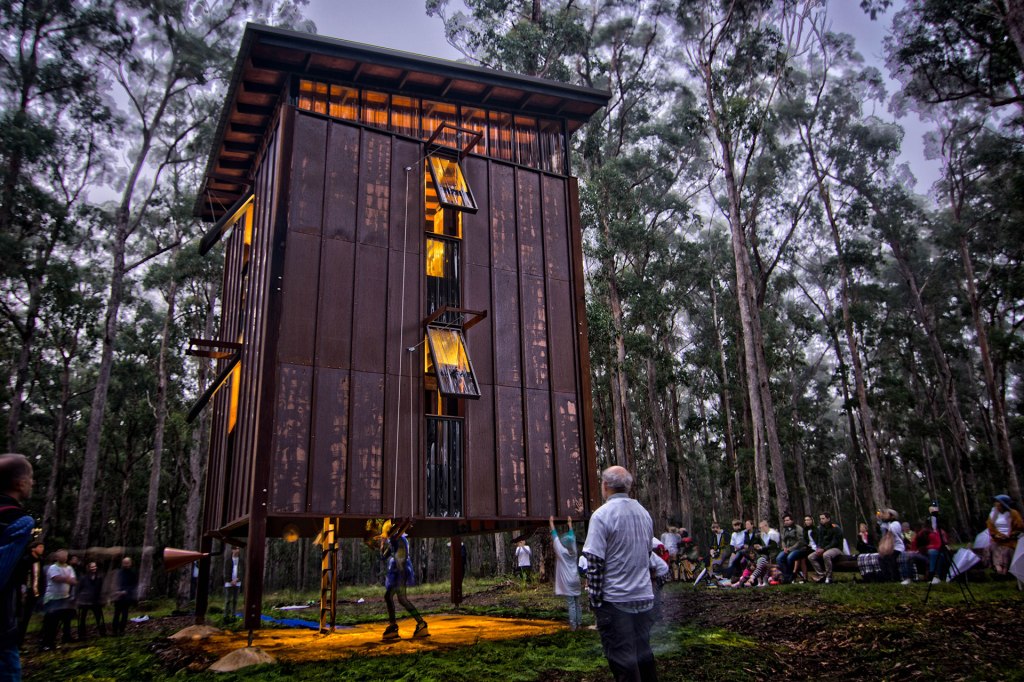
Clearly, I’m not the only one who feels this way. Architect Bruce Wolfe designed The Piano Mill, and it stands in the forest in the intriguingly named Willsons Downfall in Australia.

The Piano Mill by day

Housed inside its versatile yet utilitarian structure are sixteen upright pianos, gathered from nearby towns and packed in side-by-side, two per wall. Far from perfect, the pianos exist in varying states of playability, with the mostly in-tune pianos on the upper floor and the more questionable specimens occupying the lower. (The third level of the building is left empty and open to airflow.) Owing to the compact nature of the Mill, audiences have to stand outside of it during a performance, with pianists being the only interior occupants, though a few translucent windows provide a partial view in. Wolfe installed eight louvers in the walls that can be opened and closed to release or manipulate any sounds that emanate, making the building itself as much of an instrument as the instruments inside. For more information and some nice visuals, there’s an interview/article here.

In 2016, pianist and composer Erik Griswold wrote and took part in All’s Grist That Comes To The Mill for the Mill’s inaugural show, and this year, Lawrence English’s forward-thinking label for experimental music and sound art, Room40, has happily seen fit to re-issue a recording of that performance.

After kicking off with a thunderous blast that recedes in decay, the album quickly plunges into the aptly named “The Hive.” Sounding at first like a Cocteau Twins B-side, “The Hive” soon heats up into a menacing, swarming froth of sound. Yet as it progresses, one hears the quirks and personality traits of individual pianos rising to the surface before they get swallowed back into the turbulence. The track serves as a convocation of musician and instrument, a conjuring of the latent histories in each piano, and a palate cleanser for the adventurous array of music to follow.

“Forest Birds,” a spry, playful duet for piano and bird, courtesy of the bird life in the surrounding forest and the natural sounds filtering in through the open third floor, is followed by the first of three interspersed interludes: “Plucking,” “Grader Blades” (a piece for hammered, tuned grader blades – a nod to the work done to clear the forest area), and “Strumming.”

“Nancarrow,” named for legendary composer, Conlon Nancarrow, who famously wrote music for player pianos, and “Crashing Waves” are up next. “Nancarrow” is appropriately manic, with bright, banging chords flitting from one piano to the next, cut through by a series of random, soured scales before coming to sudden stop and then a resolute plunge into a psychotic, vertiginous cacophony that’s somehow strangely liberating. “Crashing Waves” picks up this theme, sending up cascades of chalky, ascending notes that build to a blistering peak before being cut short by the air-clearing ring of struck grader blades.

“Nancarrow”

“Magic Square,” with its 12-tone, stochastic structure, comes off as a spiky, destabilized jig while “Lightning and Thunder” features frantic glissandi, pounding, upper register notes, and vigorous percussive effects produced by the players slapping, whacking, and practically tap-dancing on the bodies of their instruments. (In a certain way, it sounds like the collective temper tantrums of children everywhere who’ve been forced to practice their scales when all they really want to do is play outdoors.) The gentle hiss of rain heard between the impressively timed, furious bursts provides a striking counterbalance.

“Lightning and Thunder”

“Three Great Parlour Themes” is a highlight of the album. It offers a revealing sampler of some of the individual qualities of each piano through renditions of “Für Elise,” Chopin’s “Prelude in E Minor,” and “Claire de lune” – piano recital classics, all. As each piece unfolds, the melody is transferred from piano to piano, with some doing a serviceable job of hanging onto the imperfect-yet-recognizable intonation and others dissolving into wobbly, waterlogged semblances of the original, all while a steady rain drips throughout in the background. Wince-inducing humor is balanced by a mournful, haunted quality. That mournful quality put me in mind of Leyland Kirby aka The Caretaker’s devastating Everywhere at the end of time project, with its songs of another era exposed in their brittle finery yet slowly falling prey to faulty, damaged memory. Griswold’s themes of crumbling histories, the fragile finitude of human life, and the restorative powers of art are all on display in this powerful track.

“Three Great Parlour Themes”

Suitably, the album closes with “The Lift,” and its ascending, hymn-like melody drifting up from some very tired-sounding but still standing pianos. There’s a well-earned moment’s rest at the song’s end, then the steady applause of a satisfied audience drifting off into the night.

The Piano Mill by night

Thanks go to Michael Hannan for his review of Michael Atherton’s, A Coveted Possession: The Rise and Fall of the Piano in Australia, which provided me with information about the piano’s early prominence in Australia. Thanks also go to Erik Griswold for his time, patience, and technical assistance.