I first heard Australian musician Chris Abrahams back in 2001 on Aether, the resplendent, endless sunrise of an album he recorded with his legendary band, The Necks. I listened to it obsessively and have been a fan ever since, but recently began exploring Abrahams’ solo work. His latest, Follower, released at the end of 2022 on the prodigious Room40 label, has become my new obsession.
“Costume” opens on a rolling fog-bed of eerie organ over which Abrahams slowly layers his materials. Bells ring, but their sound is almost coincidental, as if someone were idly lifting them and looking them over while thinking about something else. Piano drops in tentatively, an approach that feels mournful and ruminative. Abrahams gently recycles a handful of notes in a tight range, laying them down in shifting patterns. Electric keys emerge and swell, holding a chord. The track, the longest on the album, coheres as it progresses yet never accumulates or assumes a shape. From the depths of this conjecturing atmosphere, a harsh, distorted swell emerges, proceeding in billows. It takes over the soundscape and envelops it in a corrosive mist. Upper register notes on the piano re-emerge tentatively to clear the air – but the piece suddenly ends.
Abrahams’ piano playing on Follower is restrained, even minimal. It can sound at times as if he’s intentionally limited the number of notes he’s allowed himself to work with, and is trying different combinations of the same six or seven notes to decipher a code. As a result, the emphasis falls less on his melodies – though he wrings many colors and moods from such constrictions – and more on his rhythms and attack. To focus solely on his piano playing, however, is to miss the point as Abrahams brings a continually surprising array of percussive textures to these tracks as well.
“New Kind of Border,” starts quietly and is quickly ignited by Abrahams’ insistent style and trim keyboard runs. But while he plays, the track rattles and jangles and crackles in a hectic welter that continually threatens to overtake and disrupt the proceedings. With Abrahams’ intuitive sensitivity to what works, everything thrashes together with steady, palpable tension. The piece effectively resolves itself with a soothing, repeated three-note gesture.
“Sleep Sees Her Opportunity” offers up a rangy, mesmerizing environment, struck through with muted, atonal sprays of piano: frosty, one-handed runs that splinter into fragments in their flight and that put me in mind of the chillingly spectral prepared piano from the second movement of Arvo Pärt’s “Tabula Rasa.” A submerged but steady thud like a panicked heartbeat drives the track forward through bursts of shivering, chattering static, yet the overall mood remains one of mystery rather than dread.
The final track, “Glassy Tenseness Of Evening,” starts with what sounds like a stubborn car engine that won’t turn over. Soon enough, echo-drenched knocks and odd rumbles and throbs burst in, adding a previously unheard, cavernous dimension to the album, followed by Abrahams’ gentle, confined keyboard motifs. As the track progresses to its end, the engine sound recedes and is replaced by a heavily muffled throb, keeping the tension on high while the piano dreams its cyclical dreams.
In my many listens to this album, I keep coming back to its title, Follower. Follower of what, exactly? Abrahams seems to me to be in egoless pursuit of his own voice. He’s not interested in virtuosic display, something he could readily fall back on, so much as in making a space in which the fusion of contrasting sounds can emerge and express something new and uncanny. With this album, I think he succeeds brilliantly.
First: about those maps. Roughly interpretive, they were made not for accuracy so much as to serve as aids for travelers moving along certain Iranian postal routes. Fittingly, it’s the very loose, speculative nature of the maps – images both vague and specific in their abstract, dreamlike appearance – that Calderone draws on to suggest pathways to his fellow musicians as they create their music. (Calderone re-drew the maps himself for use in his project and includes them in a pamphlet available for download on the Bandcamp page. Like the originals they are derived from, they both charm and fascinate.)
As for the music, it charms and fascinates as well. “Sindarūsa,” a duet with drummer Tomas Järmir, is a carefully calibrated blend of Calderone’s steady strokes buttressing Järmir’s slowly building rolls, bursts, and cymbal splashes as they delicately unfold across his kit. “Isola di Malakān,” featuring Neva Özgen on the kemençe, a small, pear-shaped, three-stringed instrument, is a mournful mélange of textures and sighs with Calderone’s electrified double bass providing metallic swells and gusts to Özgen’s passionate flights and occasional frenzied strums. Andy Moor’s unconventional approach to guitar playing yields an array of noise on “Isola Combusta,” from waterlogged, bent notes to off-tune twangs to haunted, bell-like chimes, all of which seem to call forth a parched, keening, upper register response from Calderone that casts the whole thing into a bleak, quasi-Morricone landscape.
“Nell’oceano” finds setar master Kiya Tabassian in perfect sync with Calderone, who plays his double bass at times like a tuned drum while also sparking off some lovely harmonics to Tabassian’s focused, insistent melody. It’s a beauty. On the follow-up track, “Isola Mobile,” Gareth Davis on “bass clarinet and electronics” incinerates that beauty down to the bone as he and Calderone trade and combine some of the harshest, most prickly textures they can wring from their instruments. “Isola Di Tārān,” featuring Deborah Walker on cello, initially continues that abstracted interplay, but as the track proceeds it transforms itself into a conversation of corrugated growls, glinting overtones, and shuddering groans. There’s something both playful and mysterious at work in the racket she and Calderone kick up.
The album closes with “Le Tre Isole,” and Batir Dosimbetov accompanying Calderone on nay, an Uzbekistani wooden flute. Dosimbetov’s whispery textures and shivery blasts clear open expanses throughout the track, creating an ethereal atmosphere, but Calderone’s spare, hotwire drones – and the subtle inclusion of field-recorded conversations – keep things grounded. It’s the emptiest-feeling track here, and before you know it, it’s done and gone. But Isolario is the kind of album that you want to go back and listen to, just to see what you missed. It’s also the kind of album that yields more with each listen.
The origin of the term “thin place” can be traced to Celtic/Christian culture, and a rough definition might be a location that exists as a conduit or gateway between the immediate world and a metaphysical, ethereal realm right next to it. However, the location of any given thin place is a bit harder to pin down, since a thin place tends to “exist” both subjectively and globally, beyond boundaries and nationalities. But it’s as much an uncanny feeling about a place as it is the place itself, a sensation of other lives having passed through a place but possibly still existing in it as trace element and shadow. A nexus of the real and the imagined, a simultaneity of the is, the was, and the may be.
In a way, Iranian musician and composer Siavash Amini’s latest album, Eidolon, released on Lawrence English’s brilliant and unstoppable label Room40, is a musical thin place – a space in which Amini explores the 13th century tuning systems of Safi-al-din Urmavi, while hoping to capture a glimpse of any nascent wraiths or eidolons that might be found there. As a result, Eidolon is brimming with seething, visionary music and suggestions of all sorts of presences, both real and imaginary.
The opening track, “Ortus,” erupts like a malevolent creature disturbed from its sleep, spraying out a shifting miasma of enmeshed textures that sound like slithering tentacles, sibilant whispers, and wordless curses. The imprecations fade quickly, revealing cavernous, silty spaces girded by chest-thrumming bass. An uneasy drift across this liminal zone lands the listener in a soft and unexpected silence. Densely braided chords slowly emerge from that, chords that radiate and modulate, shine and shudder, and sound as if they’re issuing from enormous, rusting pipe organs. The chords eventually settle into throbbing drones for the remainder of the track’s duration, but the burning tension prevents any sort of hallucinatory transport one might associate with drone music. Instead, “Ortus” resolves itself in a truce between conflicting impulses, though it’s an uneasy truce at best.
“Instantia” begins with the throat-clearing, staticky sound of an electric organ wheezing into life, a gentle incursion of the tactile/real, and the suggestion of some sort of presence, at least human. A dark, glowering drone gets worked up, sounding like a chorus of demon-haunted bagpipes, before cutting out in a heart-stopping caesura. Into the airless absence, a high-pitched, drone-like cry presents itself, thick with the reedy sound of string instruments, but also sounding like a warning siren, putting the listener on notice. Amini surrounds the drone with a cycling, metallic moan, creating a sound both mournful and alien, and makes room for the two elements to twist and twine and infiltrate each other while maintaining their morphing identities.
The title of the final track, “Relictio,” refers to the recession of water from soil, a natural occurrence that leaves soil permanently exposed. The track opens with a dread-filled stasis, a foreboding, gestating combination of the strings and organs that have come before. A crackling sound, almost like thunder, splits the atmosphere and a cascade of hiss and static and feedback pours in, including a howling, panting pulse that sounds like a furious creature caught up in the outflow. Then: sudden silence, a stand-off of sorts, punctuated by short yelps and feints. Amini floods the new space with a welter of noise – riverbed drones, wall-to-wall rumbling, and, jostling on the surface of it all, a teetering, tuneless melody groaned out by what sounds like unhinged, swinging sheets of metal. (It’s hard to listen to this and not think of some of the recent terrifying and heart-rending footage of towns and cities all over the world that have been flooded; to see people instantly stripped of everything, to see motorhomes and cars and entire houses, objects heavy with meaning, reduced to rootless, lightweight trash and sent sailing.) The melee is gradually dialed down as a glowering, pulsing presence fills in and expands, clearing everything away except itself. But, mysteriously, the menacing presence becomes a retreating absence. In its retreat, the reliction begins, and a battered but ascendant series of notes ends the track, providing a fading if exhausted sense of relief.
Sometimes when you can’t find what you’re looking for, you wind up creating it yourself. What Amini has created on Eidolon – powerful, startling, deliriously overwhelming, and unexpectedly tender – might ostensibly work to open a space in which a spirit may appear, but it ultimately and convincingly proves to be the very spirit it seeks.
Iranian-born musician and sound artist mHz, aka Mo H. Zareei’s Same Room, Another Day, released on Richard Chartier’s forward-thinking LINE imprint, is a journal of sorts, a series of subjective musical states. Created in Auckland, New Zealand, in 2021, it’s the product of a two-week span of quarantined isolation.
In keeping with the tenets of minimalist serial art, the tracks on SRAD are uniform in length, each one clocking in at exactly five minutes. The track titles, shorn of interpretive influence, are the dates of their composition, with the entirety running straight through from 04-06-21 to 17-06-21. In describing the physical setting of the work’s creation, Zareei refers to an unremarkable hotel room with a standard-issue bed, sofa, and desk. His window looked out onto a construction site populated during the day by neon-vest-wearing construction workers and whatever cars happened to be passing by. By night, the only signs of life were the changing traffic lights.
From two weeks’ confinement in such meager circumstances, Zareei has created an album that’s gorgeous and moody, contemplative and engaged. Nothing on any of the tracks indicates the impatience of cabin fever or a descent into lethargy. Instead, Zareei pulls the listener into the charged atmosphere of an artist in the midst of alchemical transformation.
The opening track from June 4th breathes and pulses with glowing, breezy pads. There’s a sense of a hopeful setting out into the unknown, albeit against a persistent, steady wind. The journey continues on the 5th with those pulsing pads leading the way, but an intermittent rain arrives in a kind of electrified, pointillist spatter of notes that bounce and gather and roll away. On the 6th, a steady, high-pitched drone flattens the horizon ahead, while shimmering waves of scorched sound boil up and throbbing waves push down. No option but to keep moving. Come the 7th, there’s an oasis, a plush, layered, braided drone on which to rest.
The album continues in this fashion, with Zareei conjuring evocative, elemental scenes and sounds, opening up glimpses of landscapes that reflect the known world while indicating unforeseen dimensions within it. The tracks from the 9th and 10th for instance, share some of the suspended, otherworldly atmospheres found on Cocteau Twins’ Victorialand, while the waxing and waning cicada drone from the 13th puts a listener back in familiar territory, even as the repeating two-note motif above it, with its shifting textures, has a disorienting effect. The scouring, granulated gusts on the 15th swirl through with a bright, frosted appearance, while the closing track from the 17th seems an amalgam of all that’s come before, a summation of styles and approaches, a look back and a look ahead to eventual liberation.
Listening to Same Room, Another Day, I’m reminded that during the early phases of the Covid lockdown, owing to travel restrictions, air quality on an international scale had gone through a dramatic change for the better – greenhouse gases dropped globally to levels not charted since World War II – demonstrating that with diminished use of fossil fuels, the planet’s atmosphere was capable of improvement faster than anyone thought possible. All of which makes me think that, inadvertently, we had begun a radical experiment in transforming the way we live by reducing and curbing the ways in which we consume. While it resulted in an enormous economic shift that hurt businesses big and small – and this is not the place to talk about the staggering number of tragic and needless deaths that resulted from Covid and its mismanagement – it was the start of a necessary change, one that could have perhaps been sustained and improved on with subsidies and innovations and sacrifice. Whatever it was we were doing, as painful as it may have been, it was working.
Same Room, Another Day, for all its many changes and moods and variations, captures for me a picture – limited certainly, and perhaps willfully naïve on my part – of our world regaining a kind of homeostatic stability and healthy flux that we may never know again.
An artist’s life can be an itinerant one. If one is lucky, one can be carried along from artists’ colony to fellowship to university residency. More often, an artist sets off in pursuit of a new, inspiring locale, or a more sympathetic community. And sometimes an artist is in flight from a lethally oppressive government. Musician and sound artist Bana Haffar, who in bios and interviews speaks of herself as an expatriate from Saudi Arabia, describes the music on her latest album, intimaà, available on Touch, as coming “from a deep place of unbelonging,” yet there’s nothing plaintive or sentimental or traumatized in her material. Each track is considered and careful while retaining an open-ended feeling of exploration and the freshness of discovery.
The album kicks off with the brief, sheer blast of “Clearing,” a towering, vibrating tone-wall that seeks and spreads and radiates while also conveying, in its forceful warbling and juddering, a sense of unease. Even the title is ambiguous. Is it a noun or a verb? Does it refer to an open space, or the act of opening a space? Before arriving at something like a resolution, the track collapses in a quick fade. Spare, crystalline percussion and the smart, insistent rhythms of the follow-up “Elemental” filter in to fill the vacuum. Echo effects are soon layered on, deeper, bass-heavy beats fall into place, and the piece jerks and quickens and accelerates forward. A sudden distorted, faltering piano sample, like an insistent Beckett-esque monologue composed of four or five words that repeat and splinter and confuse, insinuates itself into the rhythm, and the song slows long enough to incorporate the new material before resuming its headlong pace – only to spin out once more and wind down in a dizzying haze of fragmented piano chords. Haffar sacrifices the latent melody of the piano for the sake of rhythm but creates a new melody in the process, fortifying the idea that the process is often the work itself. There is no distinction.
“Lifter,” with its disembodied, wordless voices and resonant emptiness, could almost qualify as dub while it continues some of the album’s larger themes of discontinuity and dislocation. Snapping, short-circuited wiring, crispy snares, and muffled buzzes provide palpable texture in the conjuring of a landscape that feels both alien and welcoming without being contradictory.
From here, intimaà switches direction, this time away from modes of dichotomy and disconnection toward something more suite-like and holistic, possibly transcendent.
“Save This Manual for the Future,” the first of three tracks that seamlessly segue into each other, is all long, languid, melancholic tones that unfurl in single sonic streamers or cluster and glow and decay in plush chords. It’s the longest track on the album and it is unapologetically beautiful without feeling indulgent. And while the future in its title is perhaps a hauntological one, and traces of the Boards of Canada are marbled through the music, Haffar brings a gravitas and intensity to her track that dispels further associations.
“Sit Still” is where Haffar’s voice becomes a musical element, singing lyrics I honestly can’t make out, other than the “sit still” of its title. In repeating the phrase, it’s as if Haffar is gently scolding herself for her restlessness and bargaining with herself to just relax for a moment. For someone searching for a sense of belonging, sometimes one has to stay in one place and let themselves be absorbed. This is where belonging can begin. Yet “belonging” can occasionally yield its own dilemmas – forced conformity, insularity, alienation. The music for most of the track is gauzy, light-struck, ascendant, but as the song moves toward its end, a deep, subterranean rumble kicks in and the heavenly pads that have been sustaining the hovering atmosphere plunge into prickly distortion. The track fades in a flickering fluorescent glare, sounding both anxious and hopeful.
That flickering pulse carries over to the final track, “All That Is Sometimes Not Considered,” which consists of an extended chord that swells and recedes, that achieves clarity then collapses back to heaving distortion, that expands and contracts while continually occupying the same amount of space. It’s a gush of unchecked emotion, both ascendant and mournful, and its insistent stuckness seems a gesture of unnamed hope and a reckoning with limitations.
For all its brevity – it’s a mere 35 minutes in length – intimaà feels epic. Haffar achieves this by packing every track with rich, engaging, exciting ideas that merit and reward repeated listens. I urge you to sit still and give it your attention.
To experience fear is, in some ways, to be returned to a childlike state, to a position of powerlessness and vulnerability. In this condition, the normal terms of engagement with one’s accustomed environment are hidden or missing altogether. The terrain, psychic or real, turns threatening, and unfamiliar, unforseen aspects of one’s personality can sometimes emerge. A ruthless, cunning aggressor takes charge of one’s personality, or one becomes a weakened, helpless victim. The change is sudden, overwhelming and total in its affect.
Explorers are unusual in that they tend to seek out this terrain, to challenge themselves by testing the limits of their endurance and resourcefulness and, along the way, stare back at their own fears, and all in the name of science. But for every Admiral Byrd that has succeeded, there have been dozens more that did not. Conditions turned lethal, materials failed, time and money ran out. Bad luck caught up with them and killed them.
Varde, from Norwegian artist Elegi (otherwise known as Tommy Jansen) on Erik K. Skodvin‘s Miasmah label, pays homage to polar exploration, while also exploring the territory of fear itself.
Jansen has imagined a trip across a wasted tundra and manufactured a sonic interpretation of what it may have been like for the explorers who ventured forward and never returned. The evocation, despite the compelling deployment of recognizable noises, is of an emotional or psychic landscape, as much as an actual polar one. The sounds of a shovel weakly scraping against something hard and unyielding, later replicated in a bow scraping the coiled surface of a taut string, until it warms and opens into a lament. Slow, string-filled surges crest and recede, renew their drives only to fall back again, buttressed by chthonic, bass-heavy rumblings. Untethered voices pass, muttering to no one. Fractured melodic lines cut into and interrupt themselves and then disappear altogether. Tolling notes from a piano’s lower register protrude from the gloomy morass of sound like steps leading downward to an unseen floor. Sled dogs are heard howling and whimpering. Taken together, these all suggest a larger failure, a doomed effort — the futility of struggle against unstoppable forces.
This is ambient music, but where ambient music once suggested peaceful, idealized zones that reflected internalized, utopian (read “drug-induced”) states of being, this new strain (which is called, without a trace of irony, “acoustic doom”) demarks a drug-free zone, a sober, somber investigation into the darker, scarier thoughts just beneath our surfaces.
There is also an alluring sadness and intrigue to this music, a familiar emotional tug, particularly when individual instruments come to the fore. Jansen manages to conjure up notions of a post-human world, the dying out and disappearance of our race. It’s an exorcism of fear, a sonic realization of the last days, a svanesang or swan song, as the third track is called. With this unflinching disc, he has turned a part of his psyche inside out and captured it in musical form as it left its hiding place.
There’s a powerful cultural tendency to romanticize the figure of the artist in general and the poet in particular. To fetishize and valorize the suffering of poets who struggle with drug addiction and mental illness. To make saints and martyrs of them, especially the ones who commit suicide, their deaths an indictment of the rest of the human race. Say what you will about their actual poetry, death has bought for them what their work might not have: immortality. An “honor” sanctioned too often by kneejerk sentimentality.
So with this in mind, every time I came across a reference to Songs for Sad Poets, I’d roll my eyes and keep moving.
Shame on me…
There seems to be something much larger at stake on Songs for Sad Poets than the tragic plight of a select group. The scope of Amini’s lament convincingly takes in the population of the planet. This is music for doomed humans everywhere, and it is unrelentingly bleak and gloriously powerful.
Songs for Sad Poets heaves with dread-filled atmospheres that seethe and undulate, that brood and glower and erupt with merciless intensity before fading back into swarming restlessness. And while the album radiates a coherent unity, each track stands out, singular in its integrity and presence. Aside from Amini’s capacious talents and vision, the strength of these distinctions are owed in part to his dedication of each track to the life and work of a particular poet. There’s no binding correlation between the music and the poet’s work – one needn’t listen, for example, to the simmering, caustic waves, insinuating and spreading across a blighted landscape before they rise up in towering solar flare blasts in the opening track, “Obsidian Sorrows,” and be expected to instantly intuit the life and work of Gérard de Nerval, to whom it’s dedicated. With that said, Eugene Thacker has contributed a series of poems that accompany each track and exist as textual counterparts to the music. A reflection and a remix simultaneously, the poems and the music coexist as much as they thrive independently.
Like slow-rolling fog, many of these tracks quietly emerge and mutate, gathering up clouds of sound that swell and recede, blending textures and timbres as they develop while avoiding any sort of narrative progression. There’s no magnetized crescendo pulling things forward, no cataclysmic explosion or grand moment ascended to. Amini carefully, skillfully conjures his elements and then gives them ample space to transform and surprise and fade away. Even the temporal boundaries of “beginning” and “end” feel irrelevant with tracks like “Demented Skies and “Smoldering Stars” reaching a kind of premature end-like silence in mid-track before they resume and head off in new directions.
Amini also scatters elements of field recordings across his tracks. The ringing silences of “A Quiet Glow” are dusted with the chatter of crickets while “A Shape Forlorn” opens with what sounds like the cycling song of tree frogs. Details like this keep the album rooted in the “real” world – and the wretched, sorrowful state of our world is, I think, a large part of what Amini is getting at.
Running beneath this album, like a searching, smoldering subterranean river of lava, is a feeling of unrestrained anger. Not a screaming kind of anger but an indelible, resolute, silent kind that gets expressed in Amini’s relentless intensity and focus. The more I listened to Songs for Sad Poets, the more I began to think that the sad poets of its title are not only the actual poets the music is inspired by, but the people who dream and, in dreaming, turn away from the harsh realities of our future as a species. The cover art depicts a landscape bereft of any evidence of human life. Is it a photo? A speculative illustration? Is it day? Is it night? Do days now resemble nights? Was this place once inhabited and has since become uninhabitable like much of our world will become? Is it the past, the present, or the future we’re looking at? We are destroying our compromised world at this point simply by living on it. How does anyone live with this knowledge and not lose all hope?
Songs for Sad Poets is a compelling, unabashedly sincere cri de cœur that is both despairing and unforgiving at the same time. A statement while statements can still be made. Listen to it and think.
The uniquely soft sound of a solo flute, traced and refracted by its warbling, water-logged echo, opens the gates to floatings, the captivating new album by Mathias Lystbæk, aka This Floating World, released on England’s Whitelabrecs.
A “concept album,” without any of the cringe-inducing bombast that one might associate with the term, floatings simply and elegantly examines a single instrument, the flute, and various ways in which its sound can be manipulated through effects pedals. While that might seem a bit aloof or analytical on paper, the music Lystbæk has created is rich with mood, color, and mystery.
A number of the tracks are improvised, which contributes to the ethereal, dreamy atmosphere. “Flicker,” breathing in long harmonized notes, glows with wintry warmth before evaporating in a windy spiral. “Winds I” is a simple, descending three-note figure that cycles in a mournful, questioning gesture while “Winds II” has a yearning reach, with Lystbæk pushing his notes upward before letting them fall into a stirring pool of distorted reverb that becomes ascendant before all fades to black. Except for a brief span of breathy texture, “Drops” is one of the least flute-like tracks, sounding more like swelling keyboard pads peppered with random clusters of percussion, as if Lystbæk had recorded his drumming fingers on the keys of his flute while not playing it. “Dust” is another outlier, opening with what sounds like the distant whine of a dopplering train whistle brushed over with silty wind gusts while a bright, high-pitched flute carves a shining figure in the air above. The longest of these particular tracks doesn’t even reach three minutes, and it’s a testament to Lystbæk’s vision for everything on floatings that when working with such breathtaking reticence, he still manages to conjure fully realized worlds. Floatings is a beguiling collection of songs, tableaux snatched from a dream journal.
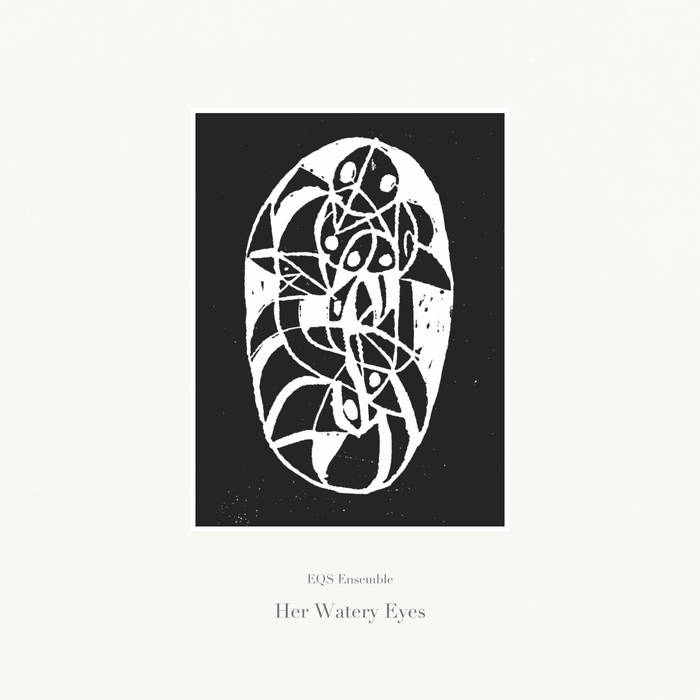
As with Floatings, the material on Her Watery Eyes, from 2020 is minimally composed and relies heavily on improvisation while maintaining an intimate and subdued aesthetic. In this case, however, the music is built from acoustic guitar, flute, cello, and keys.
Silence and space are integral. The first two sections of Her Watery Eyes are of a piece, with minor key cello, guitar, and keys played sparingly – including an audible sigh or the occasional draw along the coils of a cello string to suggest a creaking floorboard – all of it working together to evoke the feeling of an abandoned house, one in which something awful has happened and which still carries the sense of it in its atmosphere. The ensemble stretches out and wanders this dread-filled zone, exploring and expanding it into music. The second section introduces flute and voice to lend the proceedings a touch of immediacy while adding a richer, more melancholic air.
After all the foreboding, the final section arrives as a bit of a surprise. Gauzy washes of keys predominate, punctuated here and there by odd strums on the guitar or a random stroke on the cello, but as the piece progresses, the heaviness of the established mood begins to abate. The feeling of dread recedes, replaced by an uneasy, tentative calm.
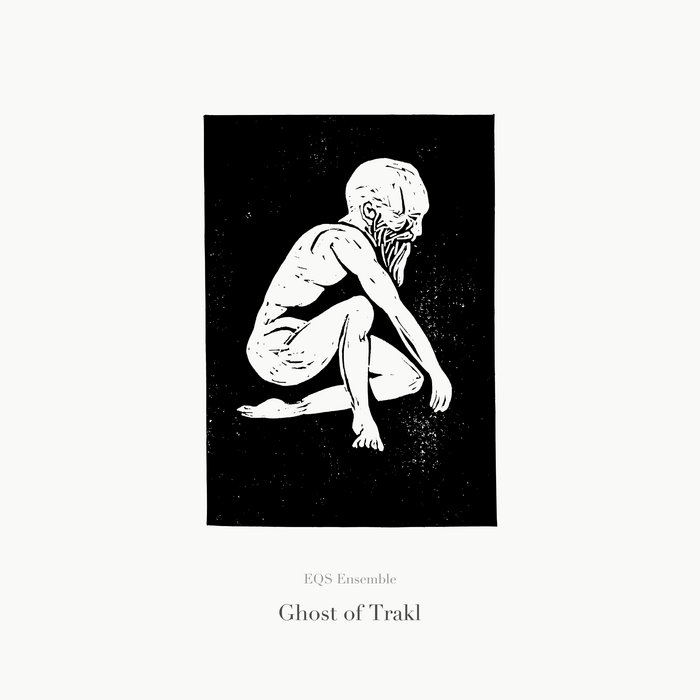
Ghost of Trakl from 2021, inspired by the troubled life and poetry of Georg Trakl, is fittingly anguished and despondent, but no less beautiful or engaging for it.
Delivered in three brief sections and sonically linked by the faint sounds of a trickling stream between each part, Ghost of Trakl has a uniformly sonorous, sighing quality that sounds at times like lamenting earthbound spirits and at times like super-slow versions of songs from The Cure’s Seventeen Seconds/Faith era. (In case you’re wondering, this is meant as a compliment.) Where Her Watery Eyes generally favors acoustic instrumentation, Ghost of Trakl relies a bit more on electric instruments. The guitar has more glint and bite, for instance, while the keys are made to wobble and growl when they aren’t providing bass accompaniment. Tactility is replaced with a kind of goth-like weight. It’s somber sounding, as a tribute to Trakl should be, but the gorgeous melodies keep it all from sinking into a morass. If there’s a quibble, it’s that it’s over too soon.
The more basic emotional responses one might have to music – it’s beautiful, it’s sad, it’s thrilling – rarely seem to apply when faced with the work of Cindytalk. Cinder, founder and primary member of Cindytalk, after starting the band in 1982, eschews traditional choices and modes in their music, an approach which yields endlessly new experiences in listening. If there’s a consistent emotional response for me toward their work, it’s a continually renewed sense of astonishment. Needless to say, this is rare. If only more artists would be so bold.
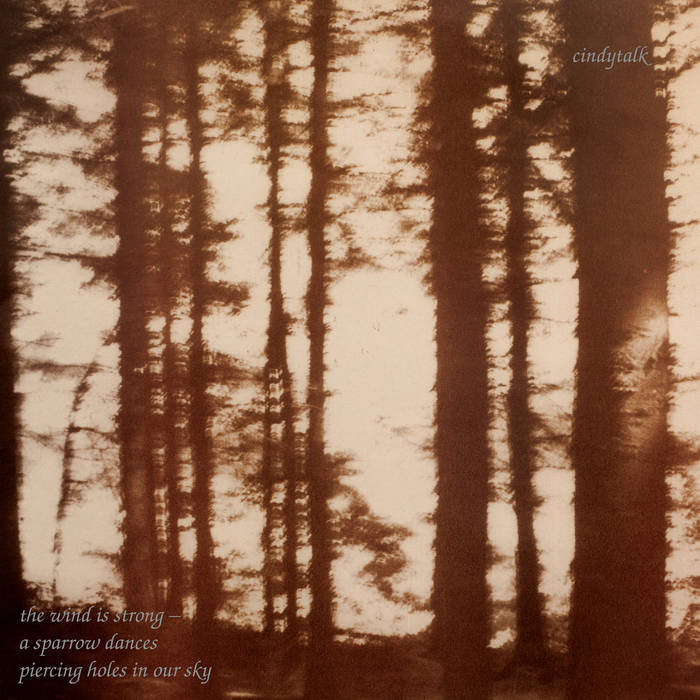
The first Cindytalk album I heard back in 1994 was 1990’s The Wind is Strong…, which was also the soundtrack to Ivan Unwin’s unreleased film, Eclipse (The Amateur Enthusiast’s Guide To Virus Deployment).
I wasn’t ready for it at the time, mired as I was in the dregs of a dying interest in more conventional rockist music. The album felt inverted to me, like some kind of wounded creature, mournful and grim and riddled with hidden recesses of pain that would occasionally rupture – between recordings of birdsong and plaintive piano – into prickly, caterwauling, electronic squalls. It mystified and mesmerized me, and spawned countless speculative visions of what that Eclipse film might have looked like. The more I listened to it, the further it pulled me in a new direction, away from the tired music I’d known, and deeper toward the startling, the unknown, and the unknowable. I wanted more.
I managed to track down a previous album, In This World, but failed to connect with it. So I made do with what I had and kept an eye out for signs of life.
Then in 2009, The Crackle Of My Soul, was released on the legendary label, Editions Mego. Fifteen years after my first encounter, I was thrilled to discover I still wasn’t ready.
With its tentative semaphore feed and parched whistling sounds slowly becoming surrounded by low-flying drones, “Signaling Through The Flames” sets the tone for the album, which unfolds into an apocalyptic landscape with negligible boundaries and little sanctuary. “Of Ghosts and Buildings” is all buzzing paranoia and disembodied surveillance, the audio feed of a captured nightmare. “Troubled Aria” is a pulsing shortwave broadcast from an abandoned post, marbled with radioactive wow and flutter, trapped in aether and recorded on a Geiger counter. Distant voices are heard in “Our Shadow Remembered” and “Feathers Burn” but they’re cold, bloodless things, contextualized in ruins of static and disrepair. Tension eases momentarily with the arrival of the “Transgender Warrior,” a floating, radiant being – and a stand-in for Cinder – cloaked in gently pulsing, diaphanous tones, but it’s the final track that completely disarms.
In “Debris of A Smile,” merciful rain is heard and very nearly felt after the relentless crackle and hiss of what’s come before, and it’s accompanied by simple, introspective piano, pointing back in some ways to the album’s title. The track slowly fades into scratch and static, but gently so, and by the song’s end, those elements are being warmed by a soothing sunlit melody that’s forced its way through the pall. Crackle is harsh, alien, single-minded in its realization, jarring yet atmospherically cohesive. Cinder’s pacing and control of their materials keeps it from becoming monotonous, or worse, claustrophobic.
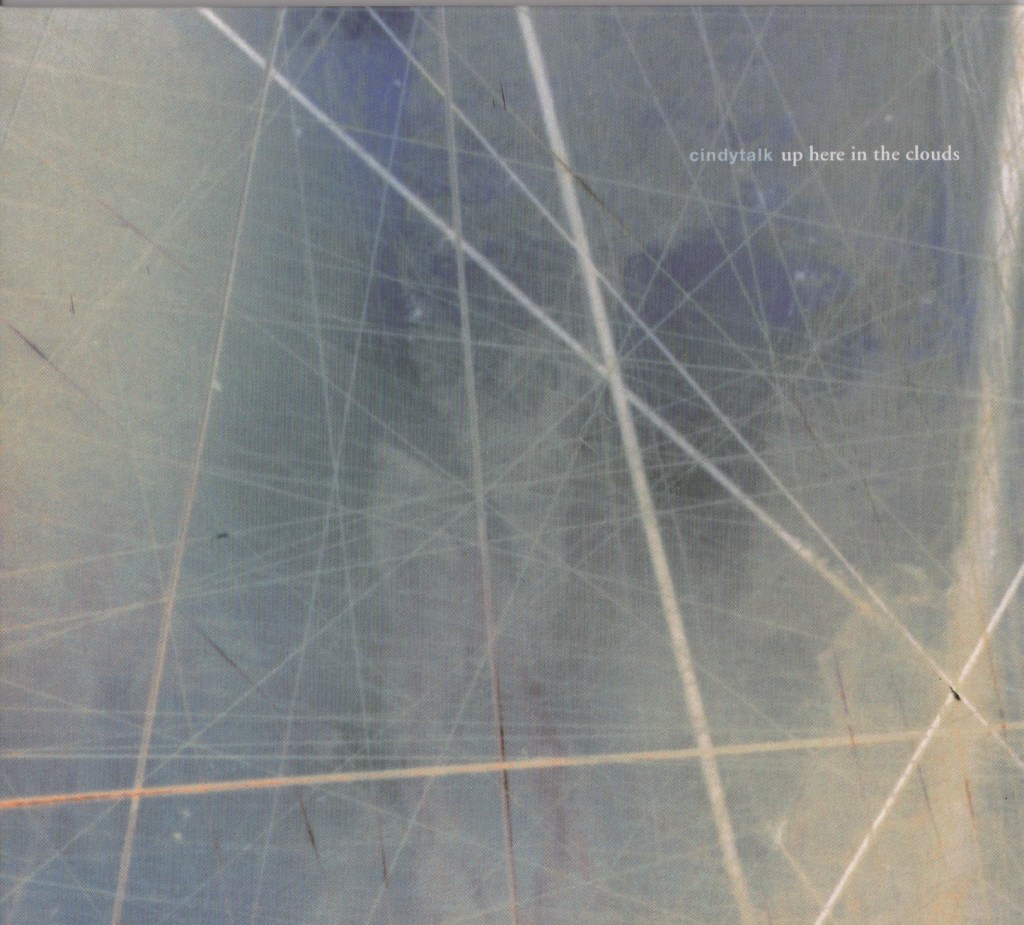
On the surface, the next Cindytalk album, Up Here In The Clouds from 2010 appears to be a companion piece to Crackle but similarities stop with the cover art.
Where tracks tend to exist unto themselves on Crackle in a largely self-contained way, they instead build and cycle and mutate on Up Here, gathering disparate elements along the way while discarding others toward each track’s fully realized expression. There’s a fresh range of textures and dynamics at work, combinatory clashes in extremes. A feeling of a search for something wholly new, rooted in recognizable, raw emotions yet expressed in a revelatory light.
Highlights are hard to choose, but the opener “The Eighth Sea,” with its panning washes of granulated static, conjures up a familiar stormy mood complete with lost souls adrift – yet the emotional affect is cool, stoic, spectral. The emphasis is on the totality of the scene, not the drama in it. A slow, steady, chugging rhythm undergirding hissing gaseous vapors initially propels “We Are Without Words” until the engine collapses and the scene is enveloped in penetrating metallic tones, subterranean groans, and warping sheets of feedback. The term ambi-dustrial, originally coined by Cinder to describe their work, fits precisely here.
“Hollow Stare” dials things back at first, setting up a gently chiming, buzzed atmosphere before bringing down a head-cleaving axe of caustic, shattering noise that thoroughly scratches every last unreachable itch for me. The nacreous, ethereal opening of “Multiple Landings” slowly gives way to frozen blasts from ancient ceremonial horns that call forth rushing layered streams before fading to silence beneath the ring of a closing bell. It feels righteously epic while gracefully avoiding grandiosity. The album closes with “Up Here In The Clouds,” a simple melody played on a keyboard, but its modest splashes of color and warmth provide the perfect ending.
Cindytalk’s next album was Hold Everything Dear , released in 2011. It takes its title from a book of the same name by writer/polymath John Berger (who took it in turn from a poem of the same name by Gareth Davis that serves as the book’s introduction) and it represents another evolution in sound for Cinder.
Some of the material for the album was written and recorded with former Cindytalk bassist Matt Kinnison during the years 2006 – 2011 (Kinnison died of cancer in 2008; the album is dedicated to both him and John Berger). The title, like the poem it’s taken from, is essentially an exhortation to open oneself to a deeper appreciation of existence, one’s own and those of others, before one ceases to be. And from the opening track, “How Soon Now,” with its field recordings of raucous children, echoing wind chimes, and dreaming acoustic piano, through to the album’s closer, “…Until We Disappear,” which seems to answer the question posited in the first title both verbally and musically, it’s clear that Cinder has rooted themselves more directly in the immediate and the temporal than on their two previous albums. The result is a more somber, reflective work, with space and silence given greater prominence.
Hold Everything Dear is an album that’s difficult to pry apart into distinct tracks with particular features. It plays out as a totality unto itself, almost as if it were one long extended work, punctuated by four brief piano interludes that offer variations on a musical theme, while reinforcing sublimated ideas of change and loss and cycles of life. Despite the leanings toward mortality, there’s nothing morose in any of it. It’s a yearning, mysterious, wistful album, rippling with evidence of lived life. Of Cinder’s Mego output, Hold Everything Dear stands apart as the work most reflective of the materialty of existence, embodying presence, absence, and impermanence.
A Life Is Everywhere from 2013, presents the sound of Cinder reinventing themselves once again.
“Time To Fall (Exterminating Angel)” opens with a bell ringing, the summoning sound of which is sent into doubling patterns and feedback before everything is subsumed in a blinding blizzard of ground glass and ascending tones. It’s this combination of the visceral and the ethereal that sets the course for the rest of the album. “My Drift Is A Ghost” is relentless with scouring blasts of static, brittle percussive cycles, and warped mournful pads, all combining to cleanse the interior of your skull as if to clear it of any preconceptions. “To A Dying Star,” a wordless homage to longing, fills that newly cleared zone, unraveling in arcing, granulated banners that spend themselves in extension before disintegrating into silence, while “Interruptum” explores even deeper space and silence with fizzing, popping depth charges, deep descending tones, and haunted notes from a church organ.
The album closes with “As If We Had Once Been,” a radiating throb of sound surrounded by clacking flashes of static. It conjures up an idea for me of what the sun might sound like in all its rotund enormity and random solar flares if it were a living, breathing thing. A bold and utterly unique album, A Life Is Everywhere at forty minutes is too short by half and one of Cindytalk’s best.
And like that album, Labyrinth is also punctuated at its beginning, middle, and end, only not by solo piano variations on a theme. In this case, they are audio clips taken from the 1983, Chris Marker-esque, non-narrative film, Ghost Dance, directed by Ken McMullen, and featuring a cameo from Jacques Derrida, who speaks of ghosts, cinema, and notions of the past. Each monologue, delivered in terse monotone (and not by Derrida), details a list of sorts. The album begins despairingly with “Sea of Lost Hopes” in which the narrator speaks over the sound of pummeling waves of a:
sea of electric eels
sea of unknown movement
far below the surface…
sea of ritualistic murder
sea of history…
sea of lost hopes
sea of despair
sea of occasional reason
sea without time
The voice is soon silenced by a welter of menacing, metallic clatter that builds before coming to an abrupt end. “Shifting Mirrors” is a track that seems to occupy a place of perpetual arrival, wherein an initial approach of creeping hiss, rattle, and crepitation is slowly layered over and replaced by an over-wound, clock-like rhythm that’s eventually pushed under by an encroaching drone that rests finally but uneasily between a somber tone and pure noise. It’s a mesmerizing, unsettling track. “In Search Of New Realities” has an almost techno-like feel with its understated rhythms and ascending pads playing out a mournful melody. It’s ironic to me that the new reality sought after is so reminiscent of an established genre, but it’s a gripping track all the same. “I Myself Am An Absolute Abyss” features a rattling snare drum set loose amidst thick waves of pressure rising and falling beneath a glittering fog of static and the occasional Quindar tone.
“Lost Unfound,” features a Cindytalk solo piano interlude; only this track also features the return of the narrator who wants:
to be inside and outside at the same time
to be the one who sees
and the one who is seen
to enter the place where space becomes time
and time stops still
to escape from time forever
Not to impose too strong a narrative on these spoken parts, but there seems to be a shift from the despair of the first piece to a kind of yearning here, even if that yearning is hopeless. Suitably the music that follows shifts gears as well. “A Wolf At The Door” at 15 minutes in length, is a vast, rain-soaked, ambi-dustrial track that swells and leans and hovers in its sonic materialization of disused space until birds can be heard chirping within it and the tone lightens. A woman’s voice surfaces, mutters something unintelligible and then is gone. Sunlight breaks through but nothing can be seen because nothing is there.
The album takes a bewildering turn after that. “The Labyrinth of The Straight Line,” a grim, tuneless techno track with an unyielding rhythm provides sonic commentary on the perils of conformity. “Sleight of Mind,” a barren ambi-dustrial track is filled primarily with random sounds of gunfire, and “Who Will Choose My Dress” is a cross-hatched thicket of silver scratched clouds that slowly morphs into an unobscured vista floating on layered, dreamy pads. The album closes with “Filthy Sun In Diminishing Light,” a dizzying melange of corrugated, fizzing textures, piercing keyboard stabs and hovering throbs that compete with each other before the track resolves in what sounds like, of all things, steel drums. In the midst of this, the narrator returns a final time:
They’re coming closer
I’ve been expecting them
They really don’t know what’s happening
They don’t know the end
There’s not much time left
The wish to stop time
Is a deathly wish
They’re going to see an image of their own struggle
With their own persona
They’ll be left with that
I’ll leave them that at least
Who are they? Are we them? This image of a very personal struggle, is this Cinder’s “gift” to the listener? Is this Cinder’s struggle with themselves? Is it a challenge from a non-binary person to a restrictive, dominant, binary culture? All of the above? None? A trip back through the album looking for answers sounds like something you’ve never heard before all over again. The Labyrinth of The Straight Line is a manifesto of non-conformity, a puzzle, and a love letter all in one. An essential work.
The tracks on Of Ghosts and Buildings are mostly lengthy ambi-dustrial things imbued with uncanny atmospheres; haunted and inhabited spaces, as the album title suggests, that are thick and seething with the ever-present, cloudy turbulence of Cindytalk crackle and electrified burr. “Long For The Future Long For The Past” puts us in a room with live electrical cables, cut and dangling to the floor, spitting out sparks in all directions. It’s a menacing environment that feels dangerously alive. In addition, the album seems to put more of an emphasis on melody, not in any predictable, patterned sense of that term, but more for use as color and mood, another element among elements instead of a determining force. “A Different Breed Of Flower,” for example, is filled with keening chords that push back against gusts of frigid static.
All well and good, however, it feels as if something vital is missing. For all the moods evoked and textures worked up, the album strikes me as too sedate, too stationary, too vacant. The exploratory principle – a key element for me in Cinder’s work – that’s so prevalent elsewhere feels conspicuously absent here.
Like Of Ghosts and Buildings,Subterminal is made up of long tracks. And like that album, the tracks have a tendency to idle, to claim space without really exploring it.
“See, Seer, Seek” opens up a vast Vantablack chasm haunted with dubby echoes and creepy respirations but lingers in the doorway without venturing into the depths. “Where Everything Sparkles And Shines” rumbles and throbs against splashes of static and piercing church organ but the track stalls, accumulating time and little else. “Systems Are Spiraling” is the highlight for me, a mournful track of random chords rolling in like waves spending themselves on an empty beach while tuneless electric wisps flash and extinguish overhead like dying stars. There’s real emotional power in it. Still, I wish the album had closed with it rather than “We Fly Away With The Birds,” a lengthy passage to nowhere.
There are no surprises anywhere for me on Subterminal. Nothing to raise an eyebrow or a goosebump. Stranger still, I feel no sense of Cinder’s presence. There’s no heartbeat in it, no pulse.
But here’s the thing. Compared with the explosive power and range of the Mego albums, almost anything else is going to sound slight. And what’s the option? Keep rolling in the same rut? I’d rather Cinder grow and change and push their art than stagnate and recycle. And who knows? Time might change my mind. A year from now, these might be my favorite Cindytalk albums. I wasn’t ready the first time I heard their work. Perhaps I’m not ready now and I just don’t know it. Either way, I’ll jump at the next thing they deliver. There’s nobody like them.
Australia has been the site of some of the most devastating and horrifying natural disasters in recent years, specifically its climate-crisis-driven bushfires of late 2019 and 2020. Scorching temperatures, drastic loss of wildlife, decimated crops, and sudden floods have all been visited on the country, making it a bellwether of sorts for future life on the rest of the planet.
In response to this rapidly evolving problem, Australian percussionist Laurence Pike has come up with Prophecy, a gentle, limber, searching collection of tracks that expresses both Pike’s anxiety about the state of the world as well as his hope for what can still be done. As he puts it: “Beyond an interest in exploring a musical language to express my own experience, my hope is that the music might share the possibility that we are truly free in spirit, and free to determine our future.”
The opening track, “Goldens” sets the tone, beginning with a ringing, metallic drumroll that sounds somewhat like a distant alarm, soon followed by Pike’s spare, jazz-inflected drumming. A stepped bassline drops in followed by a bright if muted motif on keys – and suddenly a song is born. Pike keeps all the elements in play, adding additional keys and chimes at one point to create a colorful mobile of sound before the piece drops to an abrupt close.
That appealing, loosely wrapped quality of “Goldens” is braided through the entirety of Prophecy and is indicative of Pike’s feel and vision for his music. “Nero” is a perfect example, a driving, questing track, undergirded by a fuzzed-out, monophonic drone. Pike provides tons of energy here, avoiding any sort of bombast, while worrying a tiny shaker, slapping occasionally at a China cymbal, or banging on an array of percussive instruments. You rarely get the sense that he’s using more than one or two drums from his kit at any given time, as if to suggest this is what drumming will be like in a diminished future – less grandiose perhaps, quite different than what we’ve become accustomed to, but entirely possible. It’s tight but very much open.
“Heart Of The Sky” keeps all that energy going. Pike piles on new percussive ideas and textures while a slowly pulsing keyboard throbs in counterpoint before gradually taking over the direction of the piece and pulling it to ground in an uneasy truce. Melody predominates on the pensive “Ember” which features intimate piano, sporadic, tentative percussion, and the occasional presence of a ghostly, backward-masked vocal. The track feels almost alien yet never alienating; it’s a highlight.
The second half of the album has a somewhat more subdued quality, but is no less compelling for it. The title track “Prophecy” is a stately waltz of glittering chimes, cycling keys, and tumbling drums, suspended over a subterranean pulse. “New Normal,” with the steady tension of its drumming and the cinematic intrigue of what sounds like a dulcimer, resembles a kit of parts that fit together precisely while retaining their independent functions. The burning organ drone, random flute sample, and spattered drum patterns of “Rapture,” come across like a miniature template for something by The Necks. And the album closer, “Echoes Of Earth” is evocative of an empty vista at midday, glints of light rising here and there from a dusty landscape, while Pike’s close, quietly frenzied drumming suggests a busy world of unseen wildlife.
Considering the enormous motivating themes this album is addressing, Prophecy could have become an overblown if sincere cri de cœur. By focusing on the future, however, instead of obsessing over feeling powerless in the present, Pike has avoided that pitfall and produced an album that teems with ideas and emotion. It’s improvisational but it feels carefully structured. It flirts with jazz without committing to it. You can listen to it over and over (as I have) and always find something fresh, some new hook, or idea, or feeling. Give it a try.
And while you’re at it, check out this dazzling video for “Nero,” directed by Clemens Habicht.







 Another Green Kitchen